
In Peninsular Malaysia, TNB supplies factories at 400 V three-phase or 230 V single-phase, 50 Hz. The "200A" on a listing is usually the main switchboard's rating, about 139 kVA at 400 V. A factory needs a TNB upgrade when its new maximum demand exceeds the supply TNB designed for it. Above 100A a registered consultant engineer applies, above 350 kVA TNB needs a new substation, and from 1,000 kVA supply moves to 11 kV.
What is the difference between single-phase and three-phase power in Malaysia?
Single-phase is one live conductor and a neutral, 230 V. Three-phase is three live conductors sharing a neutral, 400 V between any two: what larger motors and machines are built for.
- Three live conductors (L1, L2, L3) and a neutral (N)
- A single-phase load: one live conductor and the neutral, 230 V
- A three-phase motor: all three live conductors, 400 V between any two
- Non-domestic premises are generally supplied three-phase, at 50 Hz (TNB's handbook).
- Older nameplates say 415 V: the nominal voltage was 240/415 V until 31 December 2007, now 230/400 V (MS IEC 60038, per the Energy Commission of Sabah).
What does "200A" or "200A TPN" mean on a factory listing?
Usually the main switchboard's current rating: the building's design capacity, not what the factory uses.
- 200A
- The main switch's current rating: 200 amps
- TPN
- Triple pole and neutral: three phase conductors plus a neutral, so a three-phase supply
The supply TNB agreed can differ: it is designed around the declared maximum demand, the average kW over a month's busiest half-hour. Owners should quote the switchboard and the meter (what to prepare before you list).
How do you convert amps to kVA for a three-phase factory?
kVA = 1.732 × volts × amps ÷ 1,000. At TNB's 400 V, each amp of three-phase capacity is about 0.69 kVA.
The kW matters: TNB sets connection charges in kW, and below 132 kV wants a power factor of at least 0.85.
Need a unit with a set supply? Post the amps and phases on the request board, or send them to Chris.
WhatsApp the supply you needAt what load does TNB need CT metering, a substation or medium voltage?
TNB's handbook sets a minimum supply scheme for each band of maximum demand.
- 230 VUp to 12 kVASingle-phase from the existing network
- 400 VOver 12 to 100 kVAThree-phase from the existing networkUp to 144A100A
- 400 VOver 100 to 350 kVAFrom a feeder pillar or a new or existing substation144A to 505A150A200A300A400A
- 400 VOver 350 to 1,000 kVADirect cable from a new substation505A to 1,443A600A800A
- 11 kV1,000 to under 5,000 kVA11 kV switching station (22 kV, up to 10,000 kVA, in parts of Johor and Perak)
- 33 kV5,000 to 25,000 kVA33 kV switching station
A floor, not a ceilingIf TNB's study finds a higher scheme is needed for quality supply, the higher one prevails (ESAH 2.3.1).
- Above 100A per phase TNB meters through current transformers (CTs); below, through whole-current meters of 10A to 100A.
- Above 60 kW, TNB asks for land for a substation (PE) (Connection Charges Book 2025). At 0.85, 60 kW is about 102A at 400 V, so roughly any CT-metered supply (our arithmetic): ask early whether the park's substation already serves the unit.
When does a factory need a TNB supply upgrade?
When the maximum demand it will draw exceeds the supply TNB designed for the unit: new machines, air-conditioning or a cold room can push it over. TNB publishes no typical factory figures and wants declarations backed by the connected load (ESAH 2.2), so start from what runs at the same time:
A worked case from TNB's figures: a 200A unit, and you need 400A.
Now: a 200A unit
- Size
- About 139 kVA
- At a 0.85 power factor
- About 118 kW (91–120 kW band)
- TNB charge
- RM5,400
Needed: 400A
- Size
- About 277 kVA
- At a 0.85 power factor
- About 236 kW (181–240 kW band)
- TNB charge
- RM10,800
The resultIf the unit was declared at about 118 kW and you declare about 236 kW, TNB's upgrade charge is the RM5,400 difference. TNB charges on declared kW, not amps.
How do you apply to TNB for a factory power upgrade?
The same two routes as a new supply, split at 100A.
Up to 100A
- Who applies
- An electrical contractor registered with the Energy Commission
- Where
- The myTNB portal
- Papers
- Form G and Form H (the wiring certificates), and proof of ownership or the owner's consent
Above 100A
- Who applies
- A consultant engineer registered with the Board of Engineers Malaysia
- Where
- myTNB and TNB's local office
- Then
- TNB studies its network, sets the charge
Above 100A, step by step:
- Appoint one consultant engineerWith an appointment letter.
- Send the load detailsLoads, motors and starters, a single line diagram, the switch-room layout, a power quality declaration.
- Joint meetingAfter its study, TNB agrees the substation, cable route and metering.
- PayThe charge, plus a deposit of about two months' bills.
- Hand over substation land, if neededThe owner builds it to TNB's specification and transfers or leases the land to TNB for RM10.
- Meter and switch-onThe owner's contractor applies for the meter; TNB normally switches on when it fits it.
TNB's typical lead times, assuming no delay in local authority approvals:
A tenant needs the landlord's consent (ESAH 3.1, Appendix 2), and no supply is connected until Form G and Form H are in (Electricity Regulations 1994, regulation 14).
What does TNB charge to connect or upgrade a factory's supply?
A one-off connection charge set by the maximum demand you declare; an upgrade pays the difference between the new and existing charge (Connection Charges Book 2025, section 4.1).
A selection of TNB's non-domestic low-voltage bands; brass marks the two in the worked case above. Medium voltage: RM45 per kW.
Not the whole costThe amounts apply where substation land goes to TNB at RM10, or none is needed, within 6 km of supply. The engineer, a new main switchboard, cabling, the meter panel and any substation building are quoted separately.
Medium-voltage customers whose recorded maximum demand falls below the Reference Maximum Demand TNB sets pay a Connected Load Charge for five or six years.
How are low-voltage and medium-voltage factories billed?
TNB groups customers by supply voltage: a 400 V factory is on Non-Domestic Low Voltage, one on 11 kV to 33 kV on Non-Domestic Medium Voltage.
Low Voltage General · 400 V
- Replaced
- Tariff D
- Energy
- 27.03 sen/kWh
- Capacity
- 8.83 sen/kWh
- Network
- 14.82 sen/kWh
- Retail
- RM20 a month
Medium Voltage General · 11 kV to 33 kV
- Replaced
- Tariffs E1 and E2
- Energy
- 29.83 sen/kWh
- Capacity
- RM29.43/kW a month
- Network
- RM59.84/kW a month
- Retail
- RM200 a month
- Rates for 1 July 2025 to 31 December 2027, plus a monthly fuel adjustment on myTNB.
- Medium voltage pays capacity and network per kW of maximum demand, RM89.27 together (23.65 sen/kWh at low voltage; our arithmetic): a peaky medium-voltage factory pays more per unit than a steady one.
What should you check on a factory's power before you sign?
On the actual unit, not the brochure.
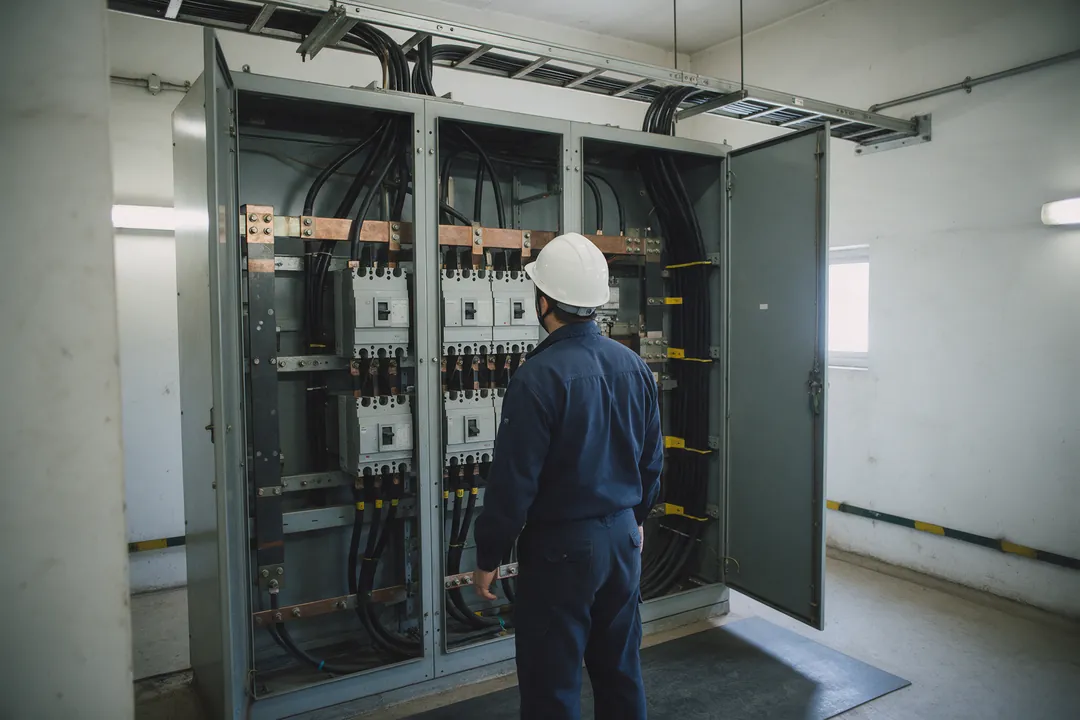 Photo for illustration purposes only
- Switchboard nameplateThe amp rating, against the listing.
- A recent TNB billThe tariff, and at medium voltage the maximum demand in kW.
- The meterWhole-current means 100A per phase or less; a CT ratio such as 300/5 means more.
- The substationWhether one serves the unit, and its rating.
- CertificatesForm G and Form H, for the wiring and later changes.
- Large motorsTNB caps the voltage step: 1% for frequent starts, 3% for one every two hours or more, 6% for once or twice a year (ESAH 2.1.3.2).
- If rentingThe landlord's written consent to an upgrade, and who pays.
Who to ask:
TNB
- Through
- Kedai Tenaga or myTNB
Electrical contractor
- For
- Supplies up to 100A
Consultant engineer
- For
- Supplies above 100A
The Energy Commission certifies the competent persons (wiremen, chargemen) who do the work. Heavy processes also raise land-use questions. General information only: TNB and your engineer confirm the supply on a given lot.
State the supply as amps and phases, such as "minimum 300A three-phase", in your requirement, or browse what is on offer now. Chris checks with owners and co-broke agents.
WhatsApp the power, size and areaSources (8)
- Tenaga Nasional Berhad, Electricity Supply Application Handbook (ESAH), online edition: Supply Application, Connection Guidelines, Metering Guidelines; launch announcement, 16 January 2025: tnb.com.my
- Tenaga Nasional Berhad, Electricity Supply Application Handbook, version 3.1, 2022 (Appendix 2): tnb.com.my (PDF)
- Tenaga Nasional Berhad, Connection Charges Book (2025): tnb.com.my (PDF); Connection Charge page: tnb.com.my/connection-charge
- Tenaga Nasional Berhad, Maximum Demand: tnb.com.my; myTNB, Understand Your Electricity Tariff: mytnb.com.my/tariff
- Suruhanjaya Tenaga (Energy Commission), Jadual Tarif Elektrik di Semenanjung, 1 July 2025 to 31 December 2027: myenergystats.st.gov.my (PDF); Pendaftaran Sebagai Orang Kompeten: st.gov.my
- Electricity Regulations 1994, regulation 14 as made in 1994 (copy filed with the WTO import licensing database): importlicensing.wto.org (PDF)
- Energy Commission of Sabah, Regulatory Requirements related to National Differences (MS IEC 60038 nominal voltages), January 2024: ecos.gov.my (PDF)
- Developer specifications: NCT Smart Industrial Park Phase 1 floor-plan brochure, nctsmartindustrialpark.com (PDF); Welloyd Industrial Park, welloydproperties.com/wip/; Sunsuria Kejora Business Park specifications, sunsuriakejora.com
Common questions
How many kVA is 200A three-phase?
A 200A three-phase supply at TNB's 400 V is about 139 kVA, worked out as 1.732 × 400 V × 200 A ÷ 1,000. At a power factor of 0.85, the minimum TNB asks customers below 132 kV to keep, that is about 118 kW. On a listing, 200A is usually the main switchboard's rating; the supply TNB approved depends on the maximum demand declared when it was applied for.
Is Malaysia's three-phase supply 400V or 415V?
TNB describes its low-voltage supply in Peninsular Malaysia as 400/230 V at 50 Hz, and Malaysia's nominal low voltage is 230/400 V in accordance with MS IEC 60038. It was 240/415 V until 31 December 2007, according to an Energy Commission of Sabah equipment guideline, which still accepts three-phase equipment rated 400 V or 415 V. That is why older nameplates often say 415 V.
When does a factory need a TNB power upgrade?
A factory needs a TNB supply upgrade when the maximum demand it will draw is more than the supply TNB designed for the unit, judged from the switchboard rating and the meter. TNB publishes no typical figures by type of factory, so an electrical contractor (up to 100A) or a consultant engineer registered with the Board of Engineers Malaysia (above 100A) works it out from your connected load and applies.
When does a factory need its own TNB substation?
TNB's Electricity Supply Application Handbook feeds a maximum demand above 100 kVA (about 144A at 400 V) from a feeder pillar or a new or existing substation, and one above 350 kVA (about 505A) up to 1,000 kVA by direct cable from a new substation. TNB's 2025 Connection Charges Book adds that a customer with a load above 60 kW must provide land for a distribution substation, the pencawang elektrik (PE).
How long does a TNB supply upgrade take?
TNB's handbook gives typical supply project lead times of less than three months at 400 V without a substation, three to 12 months at 400 V with a substation, six to 12 months at 11 kV and 18 months to two years at 33 kV, provided local authority approvals are not delayed. Ask TNB for the timeline on your own site before you commit.
How much does TNB charge to upgrade a factory's power?
TNB's 2025 Connection Charges Book prices a low-voltage supply by declared maximum demand, for example RM5,400 for 91 to 120 kW and RM10,800 for 181 to 240 kW on CT metering, and RM45 per kW at medium voltage. An upgrade pays the difference between the new and existing charge. The engineer's fees, switchboard, cabling and any substation building are quoted separately.