
Malaysian factories come in four main shapes. A terrace unit shares both side walls; a cluster block typically holds four units; a semi-detached unit shares one wall; a detached factory stands alone on its own lot. Across the six unit types charted here, published built-up areas run from 4,700 sq ft for a cluster unit to 18,628 sq ft for a semi-detached one. Shape also sets lorry access.
What are the four main factory types in Malaysia?
Four, set by how the building meets its neighbours and its lot. A terrace unit shares both side walls and sits in a row. A cluster block typically holds four units, each sharing walls with the next. A semi-detached unit is one half of a pair and shares a single wall. A detached factory stands alone with its own land on all four sides.
- Terrace: a row in which every unit shares both side walls, except the two end units, which have one side open
- Cluster: as developers in these parks use the term, four units in one block sharing side and rear walls, with open ground around the block as a whole
- Semi-detached: units in pairs sharing one wall, each with its own land on the other three sides
- Detached: one building on one lot, usually with room to drive around it. Some parks also sell a type they call link-detached: NCT’s Phase 1 brochure lists a link-detached lot of 155 by 231 ft
These four words describe shape, not quality. A terrace factory can be brand new with a floor rated for your racking, and a detached factory can be thirty years old. The condition on the title, the floor loading and the power supply are a separate matter again: they do not follow reliably from the shape, so check each unit’s own specification.
| Shape | Shared walls | Open sides | Lorry turns | Room to extend | Published built-up |
|---|---|---|---|---|---|
| Terrace | Two | Two; three at an end unit | On the park road | Almost none | 6,018 sq ft (Welloyd Type SL) |
| Cluster | Two | Two | Varies by block layout | Almost none | 4,700 sq ft (The Rubix Space) |
| Semi-detached | One | Three | Partly on your own land | Where the lot allows | 6,129-18,628 sq ft |
| Detached | None | Four | Inside your own boundary | Where the lot allows | Not used in this guide |
Read the table this way. A van, a smaller unit and mostly office plus light assembly: a terrace or cluster unit is enough. Three open sides, your own forecourt and the option to extend later: look at semi-detached. A container lorry that has to turn inside your own boundary, and shift hours that answer to nobody through a wall: go straight to standalone buildings.
Not sure which shape you need? Send Chris your process, size, power and date, and he will match it against the factories and warehouses on the board.
WhatsApp ChrisHow much building and land does each type give you?
Across the parks this guide draws on, the published built-up areas run from about 4,700 to 6,018 sq ft for cluster and super-link units, and from 6,129 to 18,628 sq ft for semi-detached ones. Those are the figures those parks publish, not a market range.
Land and building are two different numbersAt NCT Smart Industrial Park the lot size differs by unit type: its Phase 1 brochure puts a semi-detached lot at 77 by 168 or 77 by 187 ft, a detached lot at 116 by 222 ft and a link-detached lot at 155 by 231 ft. For open yard, a parked container lorry or room to extend, read the land figure.
Within one park, the two shapes can run about two to one. Welloyd Industrial Park in Meru, Klang, puts it this way on its own project page:
“comprises of 32 Semi-detached and 16 Super-linked factories”
welloydproperties.com/wip
All four units on our own listings in October 2026 are whole buildings, all of them to rent, from 67,961 to 622,094 sq ft built-up, with between 6 and 81 loading bays. Those are whole-building figures.
What does sharing a wall actually cost you?
Three things: how lorries get in and out, how much your noise and smell reach the next unit, and whether any open ground is left to build on. A terrace or cluster unit hands all three to the park’s common road and its management. A standalone building keeps them inside your own boundary - and leaves the price and the whole of the upkeep with you alone.
Terrace and cluster units: what you gain
- A lower entry price for the same floor: the land is split across a row or a block
- Built up rather than out: Sunsuria Kejora’s Phase 1 semi-detached units are three storeys
- A smaller size band, which suits an office-plus-light-assembly operation
Terrace and cluster units: what you give up
- The forecourt and the turning space: a lorry turns on the common road, not on your land
- A neighbour’s noise, smell and shift hours, one wall away
- Fewer sides that can take a door, a window or a vent
- Almost no room to extend outwards
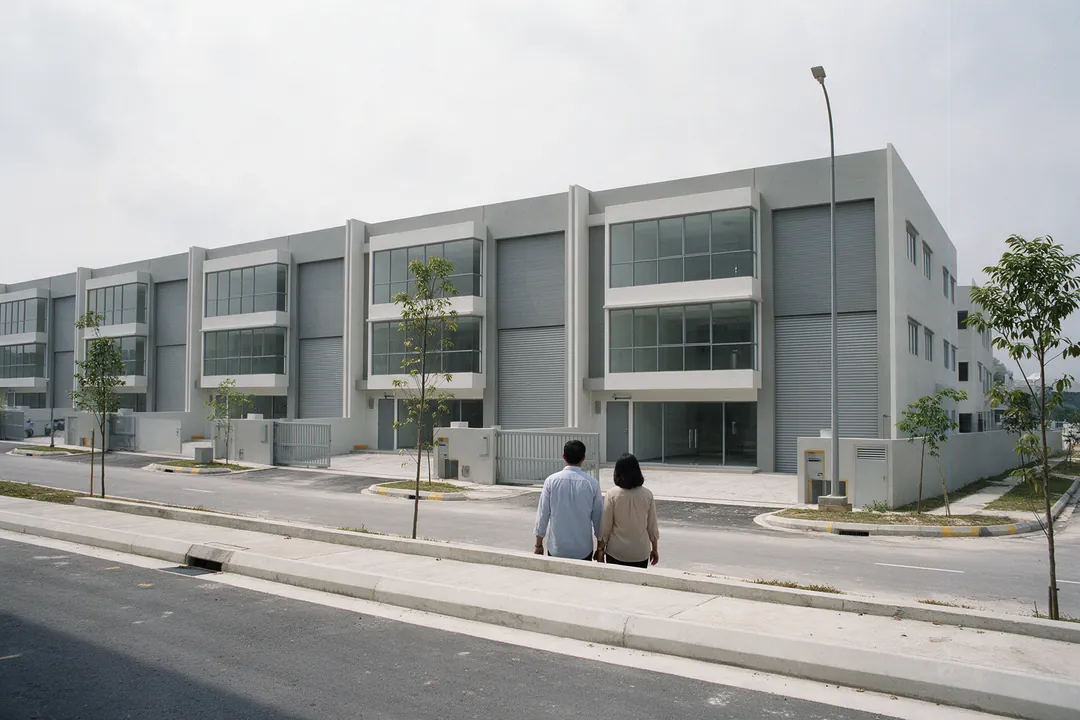 Photo for illustration purposes only
How does the shape change the price?
Shape changes how much land you are buying. Sharing a wall splits the cost of one plot across several units, which is one reason the entry price is lower. A standalone building carries its whole plot, so every figure is larger. Stamp duty is charged on the price on a tiered scale, whatever the shape.
What actually moves the price:
- Land share
- Storeys
- Office and showroom already built
- Park maintenance fee
- Power and floor loading
One published example: the South Gate semi-detached factory in Eco Business Park V is 7,500 sq ft built-up, launched from RM5,640,000 in 2024, while a cluster unit in The Rubix Space in the same park is 4,700 sq ft built-up. A managed park also carries a monthly fee - what the maintenance fee pays for is a guide of its own.
Which type fits your operation?
Measure four things before you talk about shape: your longest vehicle, your heaviest floor load, the power you need, and your output three years from now. Office plus light assembly, moved by van, and a terrace or cluster unit is usually enough. A 40 ft container lorry, or growth inside three years, and standalone buildings are where to start looking.
- Your longest vehicleCan a 40 ft container lorry reach your door and turn? Walk it on the common road, rather than reading it off a plan.
- PowerSupply is set per unit type, not by a rule of thumb: NCT’s Phase 1 brochure specifies 150 amp three-phase incoming on some types and 200 amp on others; the whole buildings on our listings with a recorded supply run 300A to 800A. See factory power: amps, three-phase and when you need an upgrade.
- Floor loadingRacking, moulds and forklifts answer to kN/m² or tonnes per square metre, not to shape. Sunsuria Kejora’s Phase 1 publishes a 10 kN/m² factory floor.
- Output in three yearsIf you plan to grow, measure today what is left between the building and the lot boundary. A terrace or cluster unit has almost none to grow into.
- Finished or builtAll four shapes can be bought finished or built from scratch. The difference between the two routes is in ready-built factory or build your own.
Send Chris the size, power, floor loading, longest vehicle, location and date you need, and say whether you want to buy or rent. He looks across all four shapes at once.
WhatsApp your requirementNot ready with the details? Start with how to write a factory requirement that gets matched. To see these shapes as built, read the park guides for Welloyd Industrial Park in Meru, Klang, Sunsuria Kejora Business Park and Eco Business Park V.
Sources (5)
- Welloyd Properties, Welloyd Industrial Park project page, which states the park “comprises of 32 Semi-detached and 16 Super-linked factories” and names the Type A, Type B&C semi-detached and Type SL super-linked collections: welloydproperties.com/wip. The Type A and Type SL built-up areas quoted here come from the per-type pages Type A and Type SL with the Phase 1 e-brochure, where they are published as images
- myBina project record 93612, Sunsuria Kejora Business Park Phase 1, category “Semi-detached Factory” and “58 units of three storey semi-D factories”: mybina.com.my
- Sunsuria Kejora Business Park, the developer’s project site and brochure, for the Phase 1 built-up areas and the 10 kN/m² factory floor quoted here, which it publishes as images: sunsuriakejora.com
- NCT Smart Industrial Park, Phase 1 floor-plan and specification brochure, for the lot dimensions per unit type (Semi-Detached A1 77′ × 168′, A2 77′ × 187′, Detached 116′ × 222′, Link Detached A4 155′ × 231′) and the “3 PHASE SUPPLY (INCOMING 150 AMP)” and 200 amp specifications: nctsmartindustrialpark.com
- EcoWorld, Eco Business Park V campaign page and product brochures, 2024, for the South Gate semi-detached factory at 7,500 sq ft built-up from RM5,640,000 and The Rubix Space cluster unit at 4,700 sq ft: ecoworld.my
Common questions
Is a "super link" factory the same as a terrace factory?
Developers label row units differently. Welloyd Industrial Park lists its row units as Type SL super-linked, alongside its Type A and Type B&C semi-detached. Do not go by the name: open the floor plan and count the walls that are actually shared.
What is a flatted factory?
A flatted factory is one multi-storey building divided into separate factory units that share staircases, goods lifts and a loading area - the industrial version of a block of flats. It is not one of the four main shapes in this guide. If the unit you are seeing is one floor or one bay inside a larger multi-storey building, that is a flatted factory, and you need to check the goods-lift capacity and how the shared loading area is allocated.
Cluster or semi-detached for a small factory: which?
Two things decide it: how many sides stay open, and whether you get a forecourt. A cluster unit shares two walls, as drawn above, and its turning space depends on the block layout. A semi-detached unit shares one wall and keeps its own land on the other three sides, which leaves room for loading and for extending later. Of the unit types charted in this guide, the cluster unit is 4,700 sq ft and semi-detached units start at 6,129 sq ft.
Does the factory type change my stamp duty?
Not directly. Transfer stamp duty is charged on the price on a tiered scale, whether the building is a terrace unit or a detached one. The rates, the lawyers' fees and real property gains tax are in stamp duty, legal fees and RPGT when you buy or sell a factory.
Do banks lend differently on a terrace factory than on a detached one?
Ask the bank: the margin and the tenure are set case by case. What lenders actually look at is in factory loans: the margin and tenure banks offer, and the documents they ask for.
Are cluster factories always leasehold?
No. Tenure follows the title, not the shape: a cluster unit can be freehold and a detached factory can be leasehold. Check the title of the unit itself. What freehold and leasehold each change for a buyer, a bank and a tenant is in freehold or leasehold factory land.